

#050 The SaaSpocalypse & What It Means for Vertical SaaS - An Investor's Perspective
Wed, 22 Apr 2026 12:52:40 GMT
Cornerstone Ventures
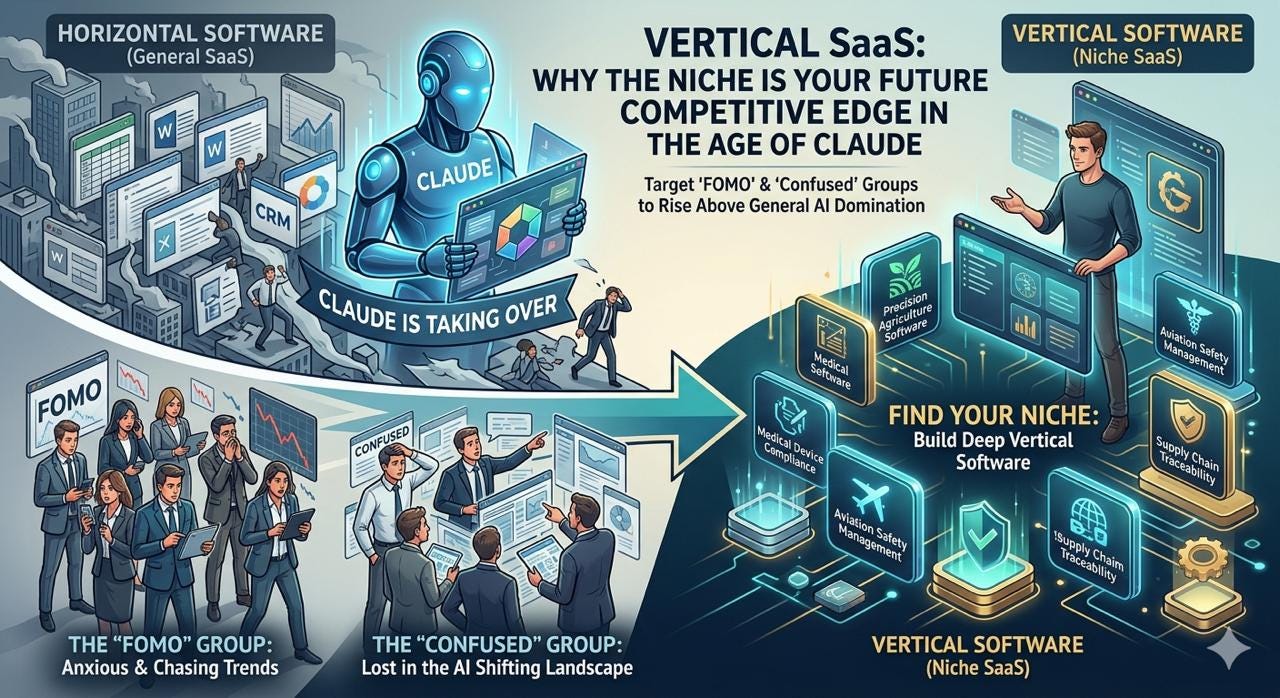
When Anthropic launched 11 new enterprise plugins for Claude Cowork in January 2026, global IT and SaaS stocks shed a reported ~$285 billion in market cap almost overnight. The market has sold off on the assumption that AI will narrow the differentiation between all software vendors, compressing moats and eroding the predictability premium that SaaS has historically commanded. The problem with that assumption is that it treats all software the same. Horizontal SaaS, broadly applicable tools built for generic workflows, is genuinely exposed. Vertical platforms, purpose-built for specific industries and use cases, are a fundamentally different proposition and in our view the market has yet to price that difference correctly.
As a fund that has backed verticalized platforms over generic software, this hit close to home, not just from a portfolio sentiment standpoint, but from a fundamental rethinking of where value accrues in a world of agentic AI. From an investor’s lens, the concern is more structural: competitive moats for software businesses are thinning, pricing pressure is mounting, and the range of outcomes for growth has widened to a point where assigning fair valuations becomes genuinely difficult.
The Case for Vertical Platforms
The real risk is not immediate extinction. It is structural compression, and it is playing out unevenly. For horizontal platforms, the threat is real and present. For vertical platforms, the picture is more nuanced. Generic AI platforms like Claude can be configured to operate in domain-specific ways and tech-forward enterprises with dedicated AI teams are beginning to do exactly that. However, the investment required in configuration, data preparation, and integration is far from trivial. More importantly, the risks around data sovereignty, regulatory exposure, and platform dependency remain largely unresolved.
A purpose-built vertical platform, by contrast, arrives with domain-specific workflows, proprietary training data, regulatory certifications, and contractual accountability baked in from day one. These are not just features. They are structural moats that a general-purpose AI plugin cannot replicate quickly or easily.
The real question is not whether vertical platforms survive AI. It is whether they can communicate their differentiation clearly and channel their commercial energy toward the right customers.
Knowing Your Customer — A Framework for Vertical Platforms
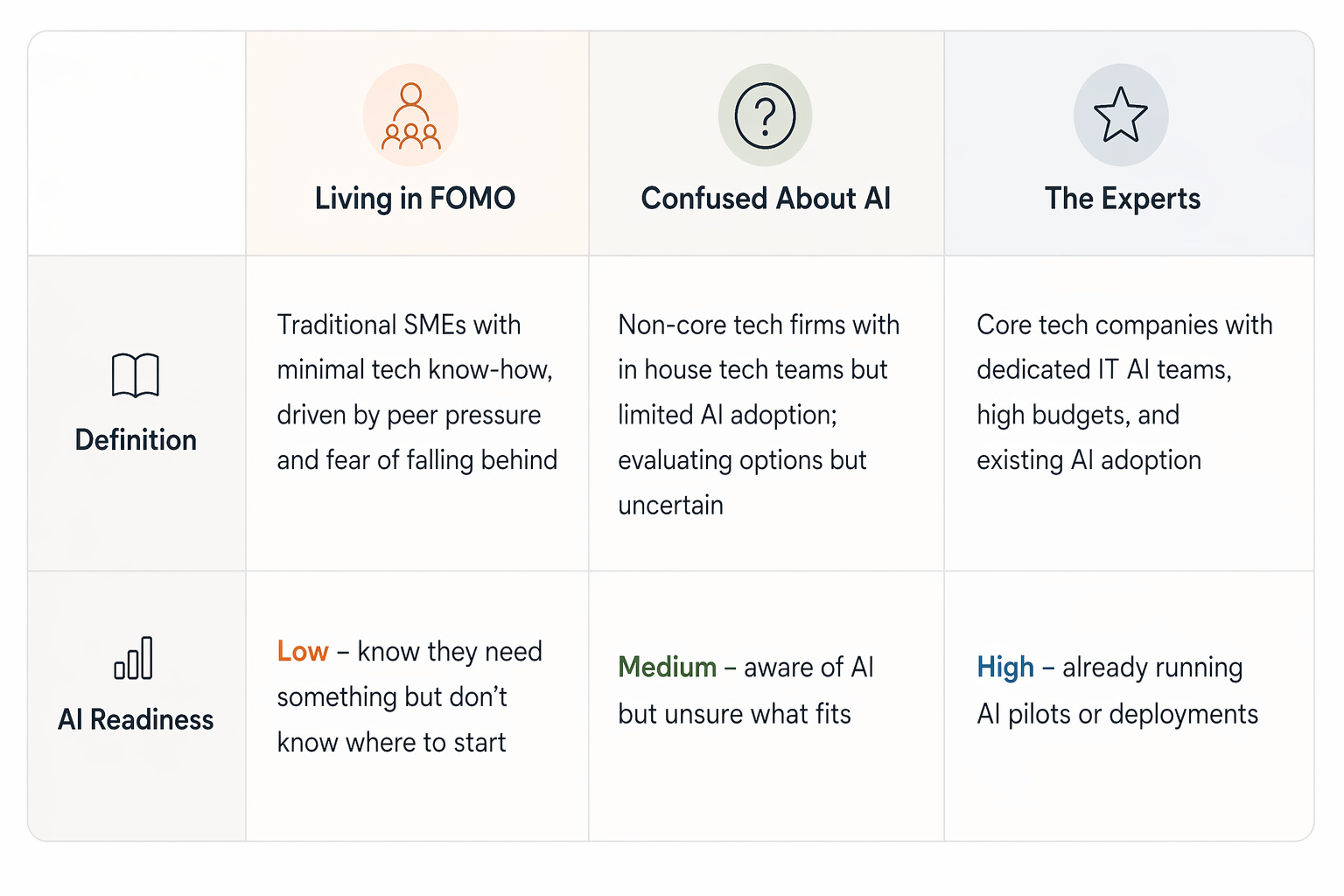
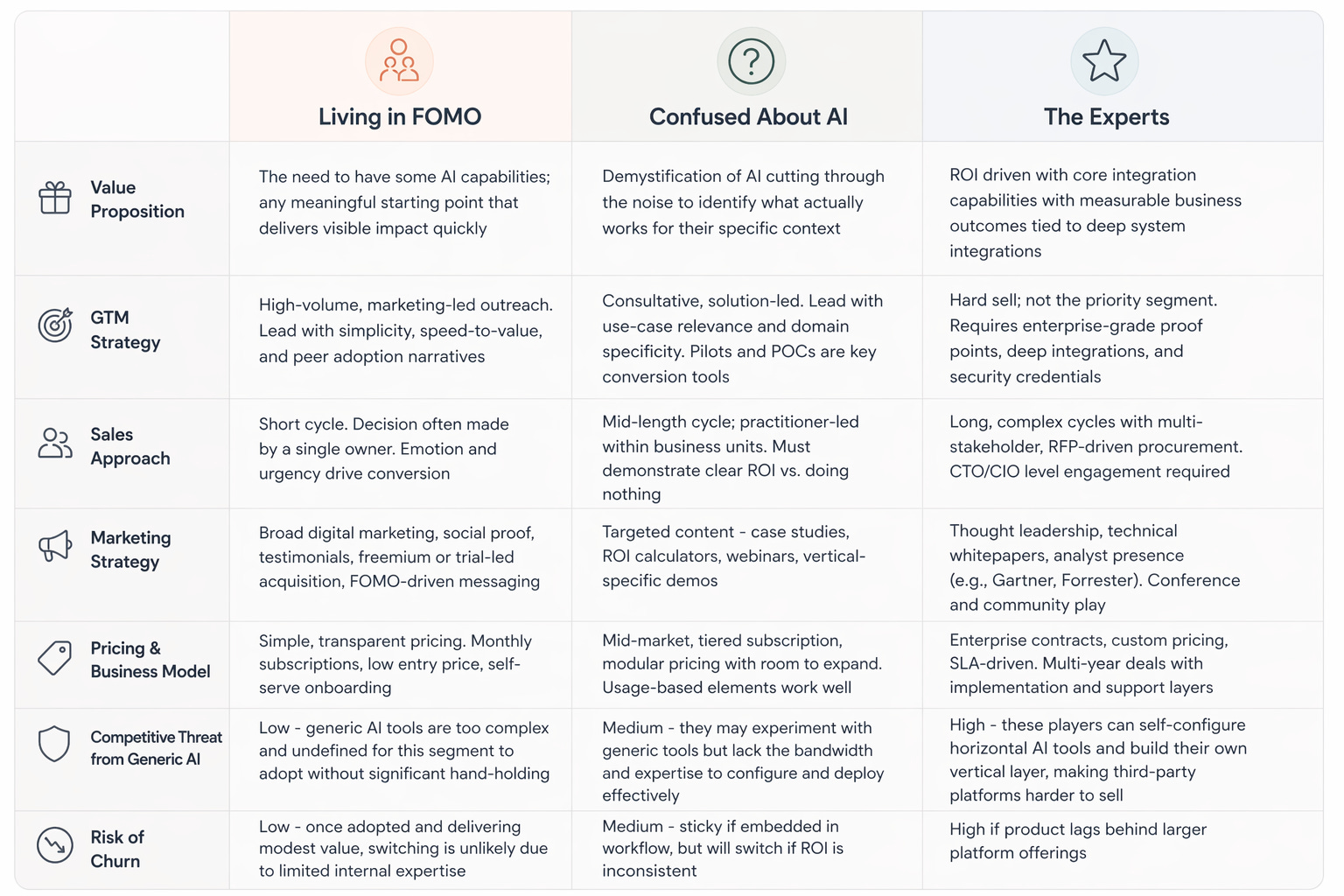
Recognizing that vertical platforms have a defensible position is only half the battle. The other half is commercial. Not every buyer is equally accessible or equally valuable in this environment, and ensuring that sales and marketing energy is deployed where it generates the highest return is what separates vertical platforms that grow through this moment from those that stall. We think about the market in three segments, each requiring a fundamentally different approach:
Go-to-Market and Commercial Strategy
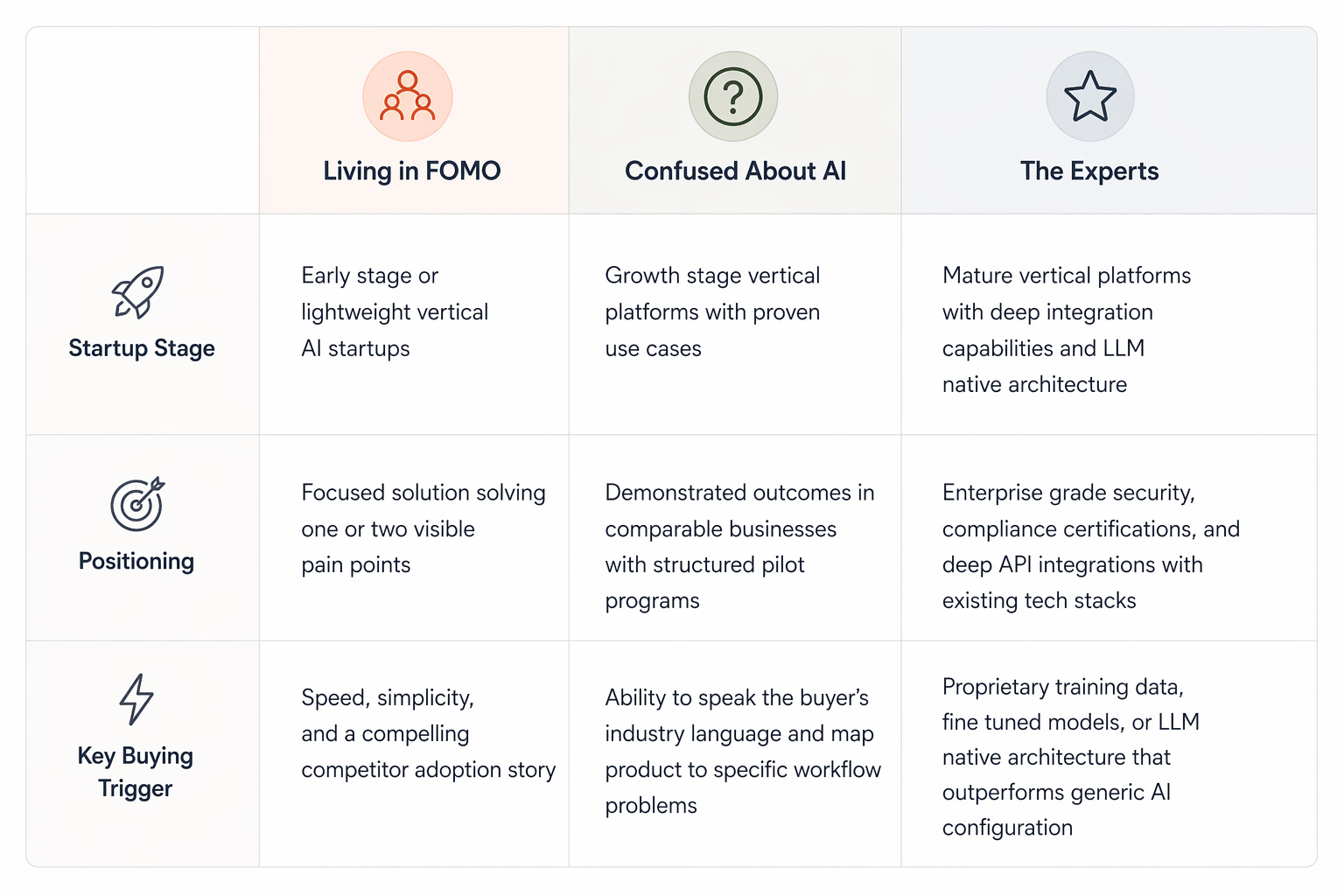
Which Vertical AI Startup Should Pitch to Whom?
Not all vertical AI startups are built equally, and the customer segment a startup pursues should reflect the maturity of its product, depth of its integrations, and strength of its domain credibility.
Our Positioning Thesis
The structural shift that AI represents is real, but it is not uniform. Horizontal platforms face genuine compression as generic AI tools replicate their core value proposition at a fraction of the cost. For vertical platforms the story is meaningfully different, and the end of SaaS narrative, more a sentiment event than a structural collapse for this category.
Real enterprise AI adoption is slow, expensive to integrate, and requires the kind of domain expertise, regulatory depth, and accountability that generic platforms are still years away from replicating convincingly.
Vertical platforms that lean into their specificity, their proprietary data, workflow depth, compliance credentials, and domain credibility, and direct their commercial energy toward the right customer segments stand a meaningful chance of not just surviving this moment but emerging stronger as the market consolidates around platforms that can demonstrate real, measurable outcomes.
The winners will not be the ones fighting generic AI head-on. They will be the ones making it irrelevant in their niche.
~Paresh
Learn more about: Cornerstone Ventures | CGES Index
Disclaimer:
The data provided on this website (www.csvpfund.com) is for informational purpose only.
Any information provided on this website or any of the other digital assets owned & maintained by Cornerstone Venture Partners Fund, Mumbai, India (“CSVP”)and managed by the Investment Manager, Cornerstone Ventures Investment Advisers LLP, Mumbai India, does not constitute investment advice or investment recommendation nor does it constitute an offer to buy or sell or a solicitation of an offer to buy or sell shares or units in any of the investment funds or other financial instruments.
The Cornerstone Global Enterprise SaaS Index (“CGES Index”) ™ is a trademark of CSVP. The CGES Index is created & maintained using a proprietary algorithm and is to be used for informational purpose only. It is not to be construed as an investment advice or investment recommendation in any of the constituent companies / stocks that are directly or indirectly part of the Index. The Index is created using publicly available data published on the websites of the respective companies. All data presented is as per our internal research and analysis leveraging publicly available data and is being presented only for academic deliberation and discussion purposes and is not to be viewed as any specific commentary / recommendation / evaluation / conclusion on any of the companies / stocks that are directly or indirectly part of the CGES Index.
CSVP also analyses, maintains, and publishes certain financial and non-financial metrics (“SaaS Metrics”) on the Index at an aggregate level, and not at a specific company / stock level that constitute the CGES Index. These SaaS Metrics are provided purely for informational purpose and CSVP assumes no liability for accuracy, suitability, or completeness of the SaaS Metrics. The SaaS Metrics are created using publicly available third-party information and CSVP does not claim any ownership of the sourced data. CSVP is not responsible for the accuracy, suitability or completeness of the information originally disclosed by the owner of the information and any information provided herein. CSVP accepts no liability and offer no guarantee as to whether the information is up to date, correct or complete.
CSVP may have used third-party data, information, and content (including all text, data, graphics, and logos) on the website. CSVP assumes no ownership and intends no infringement of rights, titles, and claims (including copyright, brands, patents and other intellectual property or other rights) of the respective owners or authorized users of the respective content. Use of such content is from publicly available sources and for indicative and informational purpose only in good faith. All trademarks and registered trademarks are the properties of their respective owners. This website may contain references or links to other websites. References and links to third-party websites do not mean that CSVP adopts the content behind the reference or link as its own. When first setting up the link, CSVP will have checked the linked site for illicit content and found none at that time. However, CSVP have no influence over the current and future design or content of such linked sites and will accept no liability for such content or design. Any use of these websites is at your own risk. The obligation of CSVP to remove or block the use of information according to the general laws from the time of knowledge of a concrete violation of the law remains unaffected.

X
Contact Us
contact@csvpfund.comGet our latest updates on
.svg)

.svg)
Contact Us
contact@csvpfund.comGet our latest updates on
Contact Us
contact@cornerstoneventures.vcGet the latest updates on
Cornerstone Venture Partners Fund
9 Aug 2018
IN/AIF1/18-19/0572
Cornerstone Ventures Investment Fund
11 Dec 2023
IN/AIF2/23-24/1406
Contact Us
contact@csvpfund.comGet the latest updates on
Cornerstone Venture Partners Fund
9 Aug 2018
IN/AIF1/18-19/0572
Cornerstone Ventures Investment Fund
11 Dec 2023
IN/AIF2/23-24/1406
Copyright © 2025 Cornerstone.
All Rights Reserved.